Can You Take Oil of Oregano and Black Seed Oil Together?
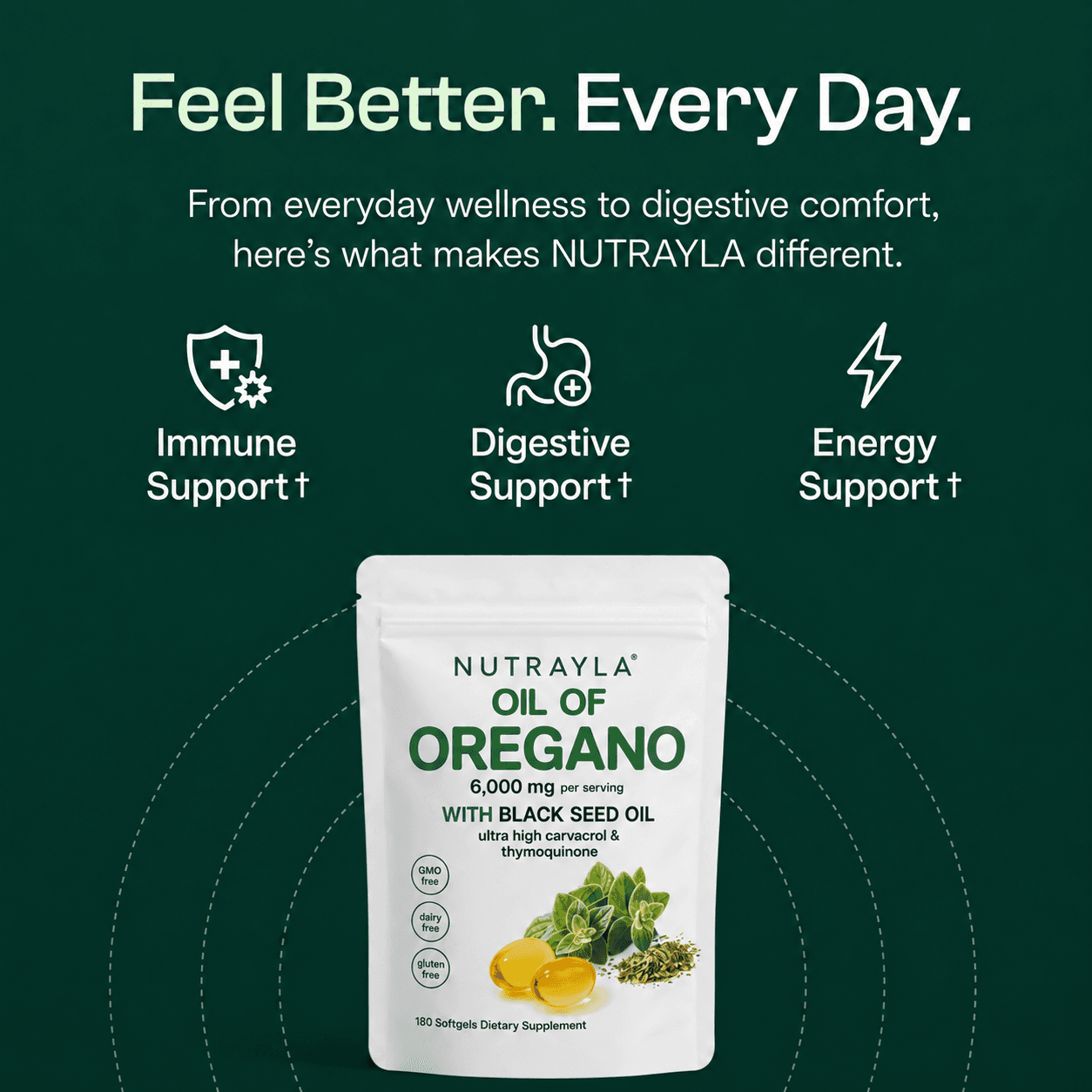
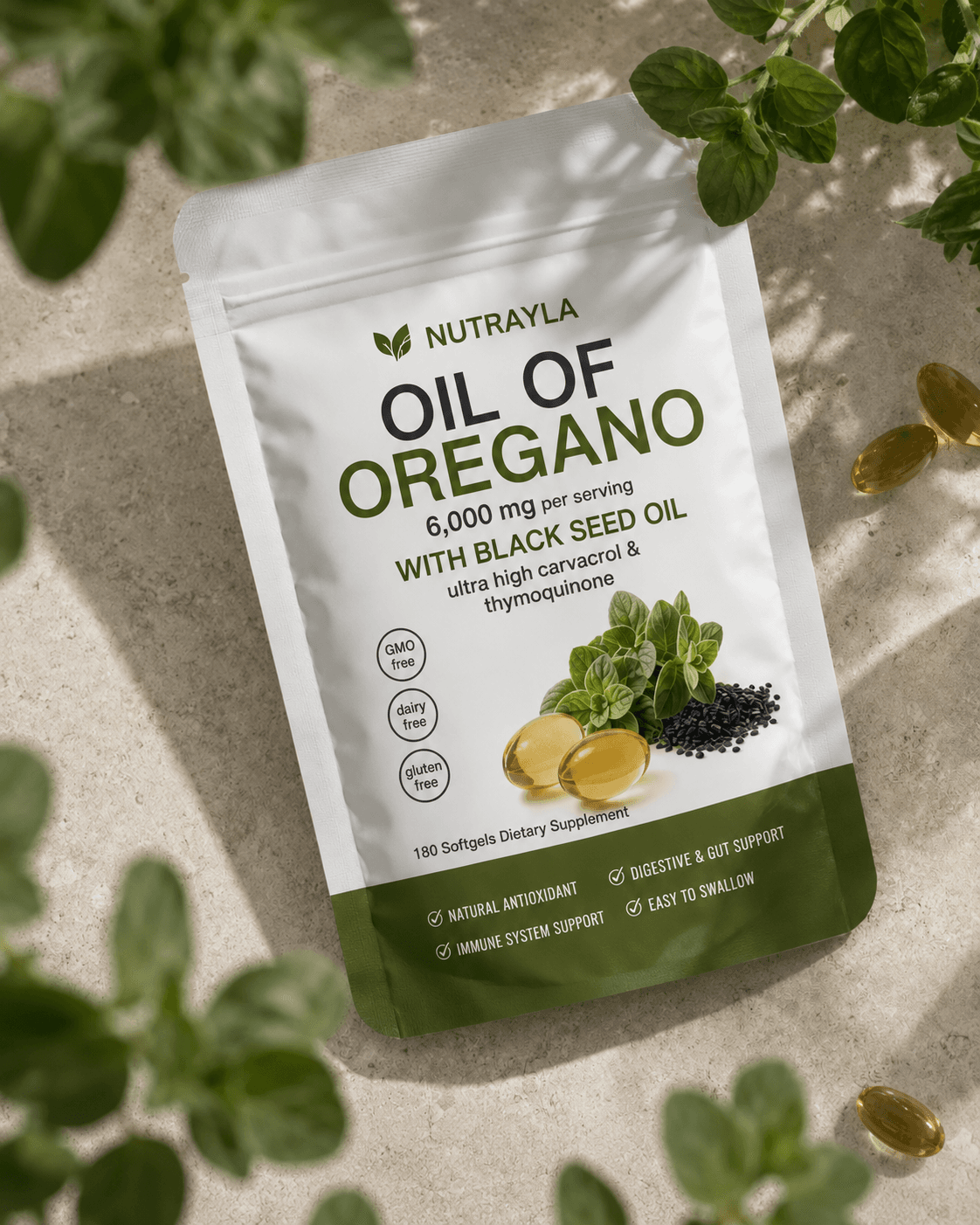
Oil of oregano and black seed oil are sold together in finished dietary supplements. That makes the combination practical, not automatically clinically proven. For an adult who chooses the pairing, a labeled softgel avoids home-mixing a pungent essential oil and provides one defined serving. Whether it is appropriate for you still depends on the finished label, your medications, health history, and clinician's advice.
- Different plant fractions — oregano oil is dominated by volatile aromatic compounds, while black seed oil is primarily a fixed seed oil.
- Different research profiles — oregano's strongest evidence is largely laboratory and preclinical; Nigella sativa has more randomized human trials, although important limitations remain.
- One repeatable format — a softgel contains the strong taste and removes the need to measure drops.
Two Oils, Two Very Different Nutrition Profiles
Oregano oil is the plant's concentrated volatile fraction. The NIH's LiverTox monograph lists more than 60 identified constituents in oregano leaves and flowers, including carvacrol, thymol, p-cymene, and gamma-terpinene. That is useful phytochemistry, but oregano oil should not be described as a meaningful substitute for vegetables, fiber, protein, vitamins, or minerals in a varied diet.
Black seed oil comes from Nigella sativa seeds and behaves more like a conventional seed oil. In one chemical analysis of Iranian seed oil, linoleic acid accounted for 55.6% of the measured fatty acids and oleic acid for 23.4%. Those percentages are descriptive, not universal: variety, growing region, storage, and extraction method can change the profile. Its research-famous thymoquinone sits in the much smaller volatile fraction.
What Human Research Says About Oregano Oil and Carvacrol
Carvacrol is compelling in the laboratory. Oregano preparations have shown antimicrobial and antioxidant activity in test-tube and animal models. But the NIH LiverTox evidence review is explicit: those effects have not been established in humans, and their clinical significance remains uncertain. A petri-dish result is a reason to keep researching—not permission to promise that a supplement treats an infection or fixes the gut microbiome.
There is some human safety work. In a phase I clinical study, healthy participants took isolated carvacrol at 1 or 2 mg per kilogram of body weight per day for one month. The investigators reported clinical tolerability and laboratory values that remained within normal ranges. That study evaluated short-term safety of a particular carvacrol protocol; it did not establish immune, digestive, or energy benefits, and it was not a trial of oregano oil softgels or NUTRAYLA®.
The evidence-aware takeaway: oregano oil has interesting chemistry and long traditional use, but human outcome evidence is still limited. 'Promising ingredient' is more accurate than 'clinically proven cure.'
What Human Research Says About Black Seed Oil
Black seed has the deeper human research file. A 2023 systematic review and meta-analysis pooled 20 randomized controlled trials with 1,086 adult participants. Across varied Nigella sativa preparations and populations, the analysis found changes in several inflammatory and oxidative-stress biomarkers, including C-reactive protein, tumor necrosis factor-alpha, malondialdehyde, and total antioxidant capacity. Interleukin-6 did not change significantly.
Biomarkers are not the same as feeling better, preventing illness, or treating disease. A separate 2023 overview of 20 meta-analyses found that only one review was of moderate methodological quality; four were low quality and 15 were critically low. Risk of bias, inconsistent results, and imprecision were common. The authors concluded that larger, better randomized trials are still needed.
So the fair summary is neither 'nothing works' nor 'the benefits are proven.' Nigella sativa has meaningful ingredient-level human research, especially around measured metabolic, inflammatory, and antioxidant markers, but the evidence does not support a guaranteed outcome for every person or every black seed oil supplement.†
Why Pair Oregano Oil With Black Seed Oil?
The formulation logic is straightforward: oregano supplies a concentrated aromatic profile led by carvacrol, while black seed oil supplies its own seed-oil matrix and thymoquinone. Putting them together broadens the ingredient profile without requiring two bottles. What has not been established is a special clinical synergy in which the combination reliably outperforms either ingredient alone.
The most concrete advantages are also the least flashy: no sharp-tasting dropper, no at-home dilution, one resealable pouch, and one serving decision. Those format benefits are real even when a person's biological response is modest or impossible to notice day to day.
How to Read a 6,000 mg Oregano Oil Label
A large milligram number on the front of a concentrated herbal product may describe a herb-equivalent amount, not the literal mass of essential oil inside the serving. For example, an extract ratio can express how much starting plant material corresponds to a smaller amount of finished extract. Those are different measurements, and neither one tells you the carvacrol content by itself.
- Check the serving size before comparing two products.
- Distinguish the actual ingredient amount from any herb-equivalent number or extract ratio.
- Look for the botanical identity—such as Origanum species and Nigella sativa—rather than relying only on a common name.
- Read the other ingredients, directions, and warning language on the finished package.
- Treat third-party testing or standardization as a claim that needs product-specific documentation, not something implied by attractive packaging.
Safety: Natural Does Not Mean Risk-Free
Culinary oregano and a concentrated oregano oil supplement are not interchangeable exposures. LiverTox notes that higher supplemental doses can cause abdominal discomfort, heartburn, nausea, bowel changes, dizziness, headache, or rare hypersensitivity reactions, and advises against medicinal oregano doses during pregnancy. Lactation data are limited. Black seed is generally described as well tolerated in short clinical studies, but mild gastrointestinal effects and rare rash or hypersensitivity can occur, and products differ substantially.
The FDA's consumer guidance recommends following the label and speaking with a healthcare professional because supplements can interact with medicines, affect laboratory tests, or matter around surgery. Ask first if you take medication, manage a health condition, are pregnant or nursing, are planning surgery, or are considering the product for a child. Stop use and seek advice if you experience a reaction.
Research Sources
- NIH LiverTox: Oregano — chemistry, limits of human evidence, tolerability, and safety context.
- Safety and tolerability of carvacrol in healthy subjects — one-month phase I human safety study.
- Chemical composition of Nigella sativa fixed and volatile oils — fatty-acid and aromatic-compound analysis of one seed-oil sample.
- Nigella sativa and inflammatory and oxidative-stress biomarkers — 2023 systematic review and meta-analysis of randomized trials.
- Nigella sativa and health outcomes — 2023 overview grading the quality of 20 systematic reviews and meta-analyses.
- NIH LiverTox: Black Cumin Seed — clinical-use and short-term safety overview.
- FDA 101: Dietary Supplements — labeling, regulation, interactions, and consumer safety.